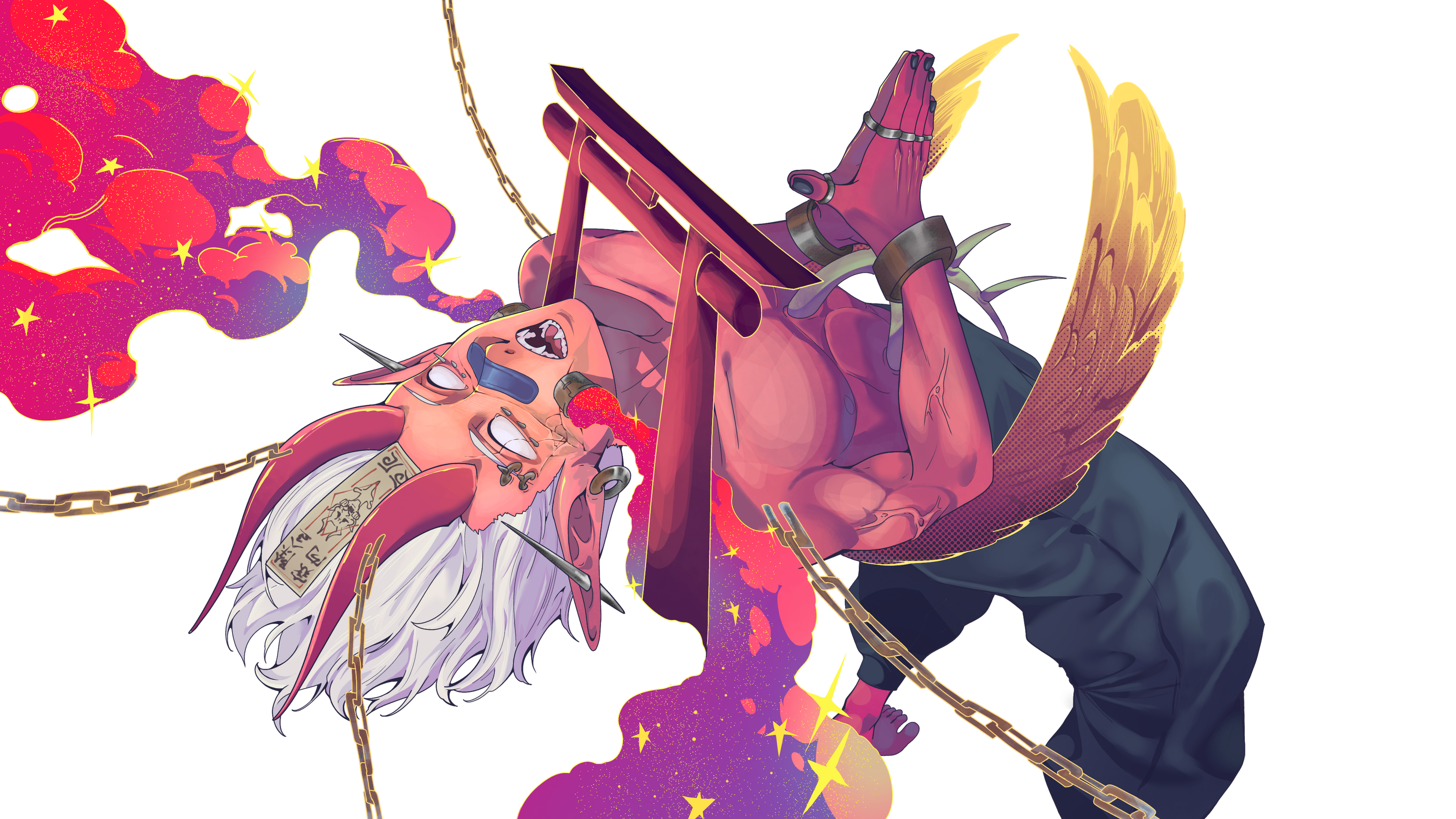
OniVT__ Lore

As recorded history tells it, the Heian period is defined as a golden age of ancient Japanese culture, when the imperial court perfected poetry, aesthetics, and ritual, turning Japan away from foreign influence. In reality, a hidden history tells a far darker tale, one where the veil between the living and the supernatural wore thin. It was not only an age of elegance, as recorded, but an age of ceaseless watchfulness and conflict against evil yōkai and restless spirits. None were more feared than the Oni.
Far from the capital of Heian-kyō stood an abandoned shrine in a remote mountain province, where tall cedar woods ascended toward the clouds and dense mist danced between their trunks. It was a humble small hokora shrine, its wood dark and warped by age, its shimenawa rope frayed yet unbroken. Its caretaker was a young Shinto monk whose name has long since been forgotten. He tended the shrine alone, offering the kami rice, salt, and saké. The villagers came only when compelled; they bowed low, made offerings, and spoke in hushed tones of the crimson-skinned Oni that stalked the forests beyond the shrine.
It was rumoured the Oni arrived with the new moon, and that lesser yōkai followed in his wake, drawn to his corrupted spirit as decay draws flies. Crops blackened overnight. Waters turned foul and brackish. It was when a band of traveling musicians had members disappear along the mountain roads, where only scattered sandals and broken prayer beads remained, did the monk understand what was going on. The monk did not dismiss the rumors that he received by the remaining troupe, one a biwa player who wore the mask of a Tengu, one who wore the mask of a Hyottoko and played the taiko he carried strapped to his back, and the last who wore the mask of a Kitsune and made melodies with his Shinobue flute. The young monk understood kegare, the stain of spiritual impurity, and how it festers, drawing misfortune. He believed the kami had led these people to him, so together they might restore what had been disturbed.

On the night of a blood moon, when the veil between worlds thinned to its weakest thread, the young monk and a select few brave members of the troupe ascended through the mists. The sacred path led deep into the forest, where the moon above was almost entirely blotted out by the trees, until he passed beneath a torii gate half-swallowed by roots and moss, opening into a clearing. Once a holy place, now it was shattered, defiled. The Oni itself grinned as the group approached, its skin crimson, horns rising upright, and hair pale as snow. A slow, mocking applause at the bravery the monk had shown in coming to oppose him. The air bent around the Oni, heavy with kegare, and lesser yokai twisted in its presence, bound to its will. The monk did not raise a weapon nor invoke violence. Instead, he pressed a paper talisman against the torii and together with the troupe began to chant norito, ancient sacred prayers.
Every word invoked the will of the kami, purifying and binding. His voice remained steady. Lines slipped in and out of sight around the Oni, a kekkai forming, closing in, like an invisible cage. The creature lunged, furious. The forest shook under its rage. Trees split, and the air trembled with the crash of brute force against sacred rite. Yet the monk stood, observing, waiting for an opening. When it came, he stepped forward without hesitation and planted an ofuda upon the Oni’s brow, its ink burning alive with invocation. In that moment, he gave all he had, his breath, spirit, and life. Offering himself as the anchor of the seal. The wind wailed around the sound of the musicians and the clashing duo. The small doors of the hokora burst open behind them as though answering his sacrifice. The shimenawa swung loose, then lashed outward from the shrine. Paper shide whipped wildly as the sacred rope coiled around the Oni, binding its wrists and ankles with relentless strength. The crimson demon howled, a sound that rattled through the pines. Then it was forced inward. The Oni’s body folded impossibly into itself, drawn deep into the shrine by a vortex of wind and divine pressure.
With a thunderous crack, the doors slammed shut the three musicians standing in awe. Silence followed deep and absolute, as though even the forest held its breath. At last, the ofuda from the forehead of the Oni reappeared across the shrine doors, its markings flickering faintly before settling into stillness. The seal was complete. The Oni was not destroyed, but contained within sacred bounds, its fury reduced to a muffled presence beneath the quiet of the mountain.

Within the shrine the Oni’s power was nullified. There he remained, sealed for a thousand years. Yet he was not entirely alone. During the ritual another entity was drawn into the cramped shrine, a nekomata, a cat whose tail had split into two, each tip flickering with small motes of blue fire. The Oni named the cat Fig, and the small black-and-white creature became his only companion, his only friend, throughout the long centuries of confinement. Beyond the shrine, the world shifted and faded. The wood rotted, moss spread, and the forest reclaimed what had once been sacred ground. The tale of the Oni slipped quietly into obscurity. Within those sacred bounds, something stranger still occurred. The shrine did not merely contain the Oni, it purified him. The kegare that once clung to his spirit was slowly worn away, leaving behind not rage, but a strange and unfamiliar calm. It was, in the end, the most unlikely of circumstances that led to his release.
A student arrived at the forgotten shrine, tasked with community service as part of her school’s Occult Club. She worked methodically, scrubbing graffiti from the torii gate and washing the stone courtyard before the hokora. She left the shrine itself for last, the oldest and most fragile structure of all. Water, soap, and time are unkind to paper. As she scrubbed away years of dirt and neglect, she also began to erode the ofuda that was sealing the shrine doors. From within, the Oni and Fig saw it first, a thin line of light breaking through the darkness, which grew, and grew.

Then, at last, the seal gave way. As violently as the Oni had been drawn inside, he was expelled and cast outward in a sudden force, crashing into the girl and sending her phone skittering across the stone tiles. She fled in terror without looking back. The Oni rose slowly, steadying himself before turning to Fig, who shook off the fall with a sharp flick of its twin tails. Only then did his attention drift to the strange object lying nearby, a small construct of glass and metal. He lifted it, studying its surface.
Within it, tiny figures moved. Entranced, he watched as images shifted and voices played from within the device, its glow reflecting faintly in his eyes. Holding it carefully, he began to walk down the sacred path as he watched the stream, the small girl talking and chatting to each word that popped up on the screen, while displaying a game alongside her. Oni carefully crossed through the cedar forest, away from the shrine that had held him for so long. The path was shorter than he remembered and before long, the forest gave way, not to wilderness, but to the edge of a school.
The girl stood there, half-hidden behind a man in a suit, pointing toward the red-skinned figure emerging from the trees. The man stepped forward, composed, though not without caution. He explained that the Oni had been sealed in a shrine just beyond the school grounds, and that his sudden appearance had caused considerable distress among the students, particularly within the Occult Club. As he spoke, a measured smile formed on his face.
The Occult Club had long been a burden on the school’s resources, an inconvenient afterthought tolerated more than supported. Now, however, an opportunity had presented itself. The condition was simple. The Oni would remain, and in doing so, he would serve as the club’s Class Coordinator. Refusal would result in his immediate return and resealing within the shrine. Whether or not such a thing was truly possible did not matter. It was not a risk the Oni was willing to take. The Oni signed on board, under the secret condition his students taught him what it was these little people in the glass were doing, and how he too might do it. Learning streaming in exchange for talks and teachings of curses and spirits that were actually real. The red skinned devil became a Streamer.